Steward the land
The HNA sits on the ancestral Huchiun territory of the Chochenyo-speaking Ohlone people.
Stewardship didn’t start with us, and we’re committed to doing our part while continuing to learn and listen.
Stewarding the Hillside: A philosophy of life
For thousands of years, the Huchiun tended these hills, knowing every plant and season by heart. We walk here as guests, in gratitude, inspired by Tending the Wild by M. Kat Anderson and The Ohlone Way by Malcolm Margolin, which reveal how Native peoples shaped and cared for this land as kin. Just as important are the encounters we seek with Native people today, whose knowledge is living and whose relationship with this land continues.
So we show up. We spend time in the field and watch the ecosystem turn with the seasons. We question the patterns, and we trust our gut and our connection with nature.
We are also inspired by Wangari Maathai, Nobel Peace Prize laureate and founder of the Green Belt Movement, who often retold the story of the hummingbird in the forest fire. While the other animals fled or despaired, the hummingbird kept flying to the flames, releasing a few drops of water at a time. Told it could not possibly make a difference, it answered, “I’m doing the best that I can.” For Maathai, the story was about values: people who act from what they believe can sustain their work for the long haul. So we do our part, drop by drop, and in tending the hill, we find that it tends us back.
Stewarding the Hillside: What It Looks Like in Theory
We are inspired by the Bradley Method (Passive Restoration)
Developed by bush regenerators, the Bradley sisters, in Australia
Focuses on working with natural processes, not against them
Core Principles
Start with healthy native “islands”
Understand their habitat conditions and ecological context
Work from best to most degraded areas
Use minimal disturbance (mainly hand weeding)
Give native species a competitive advantage
Allow natural seed set and dispersal
Let native plants regenerate naturally from the seed bank
Stewarding the Hillside: What It Looks Like in Practice
Plant ID, phenology & monitoring
Updated Native Plant List & Ongoing Population Monitoring
Habitat Identification:Soil, geology, hydrology, and site history analysis
In progress: a restoration-focused map of the HNA.
Restoration approach to date
Adaptive stewardship: Learning from the land + Improving practices over time
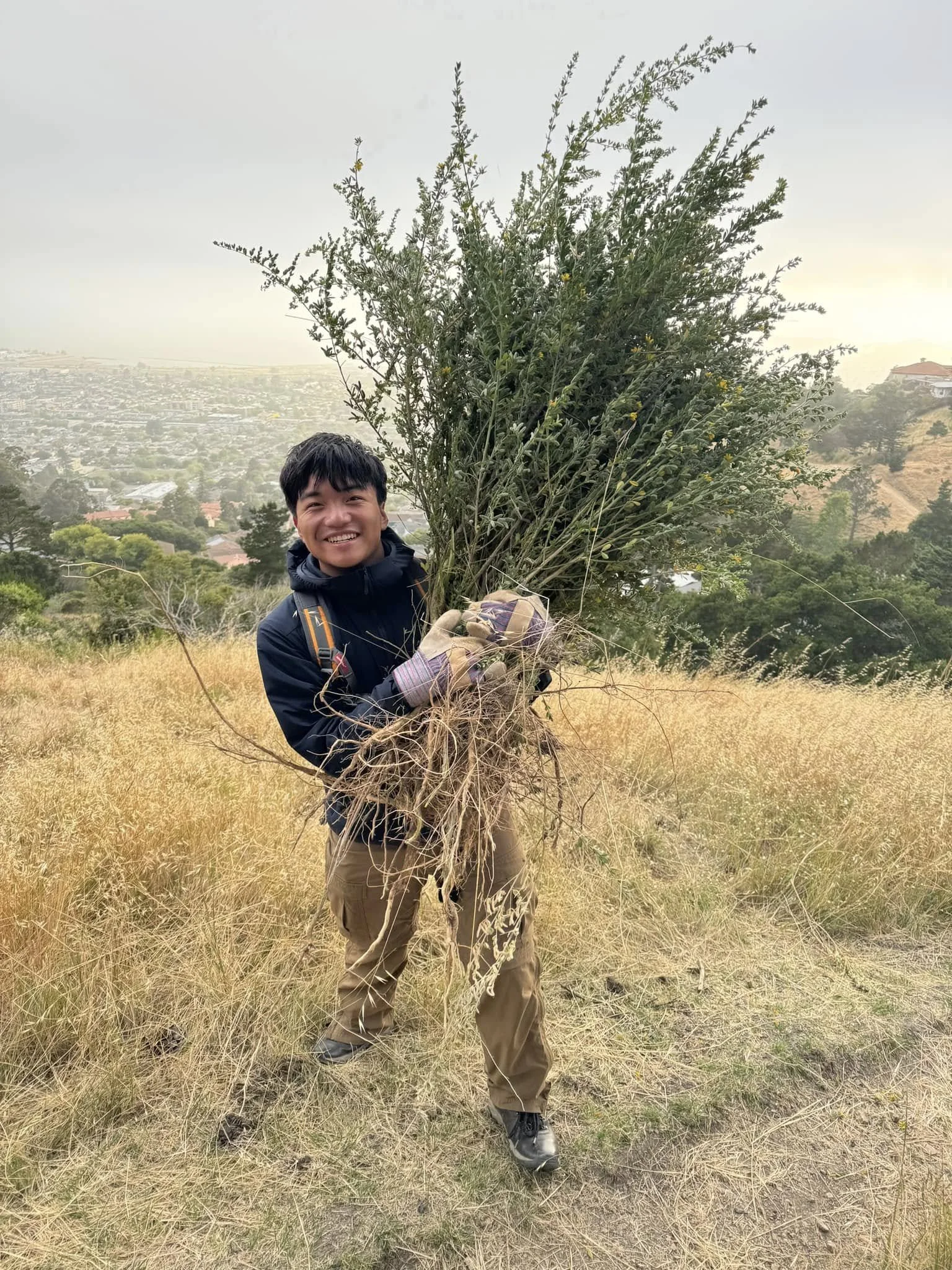
Foundational work: French Broom removal
Maintain legacy areas
Builds on years of work by Friends of Five Creeks and Trail Trekkers
Revisit annually to remove new French broom seedlings
Long-lived seed bank (>30 years) requires sustained follow-up
Sustain efforts in newly opened areas
First 3 years are critical
Ongoing management of disturbed soil and heavy seedling recruitment
Maintain areas cleared by Measure X crews in upper Madera (thistle and broom removal)
Triage (like an emergency room): prioritize early weed management, targeting species such as crofton weed, field calendula, and stinkwort before they spread.
Outcome
Gradual, low-impact restoration that builds resilient ecosystems over time