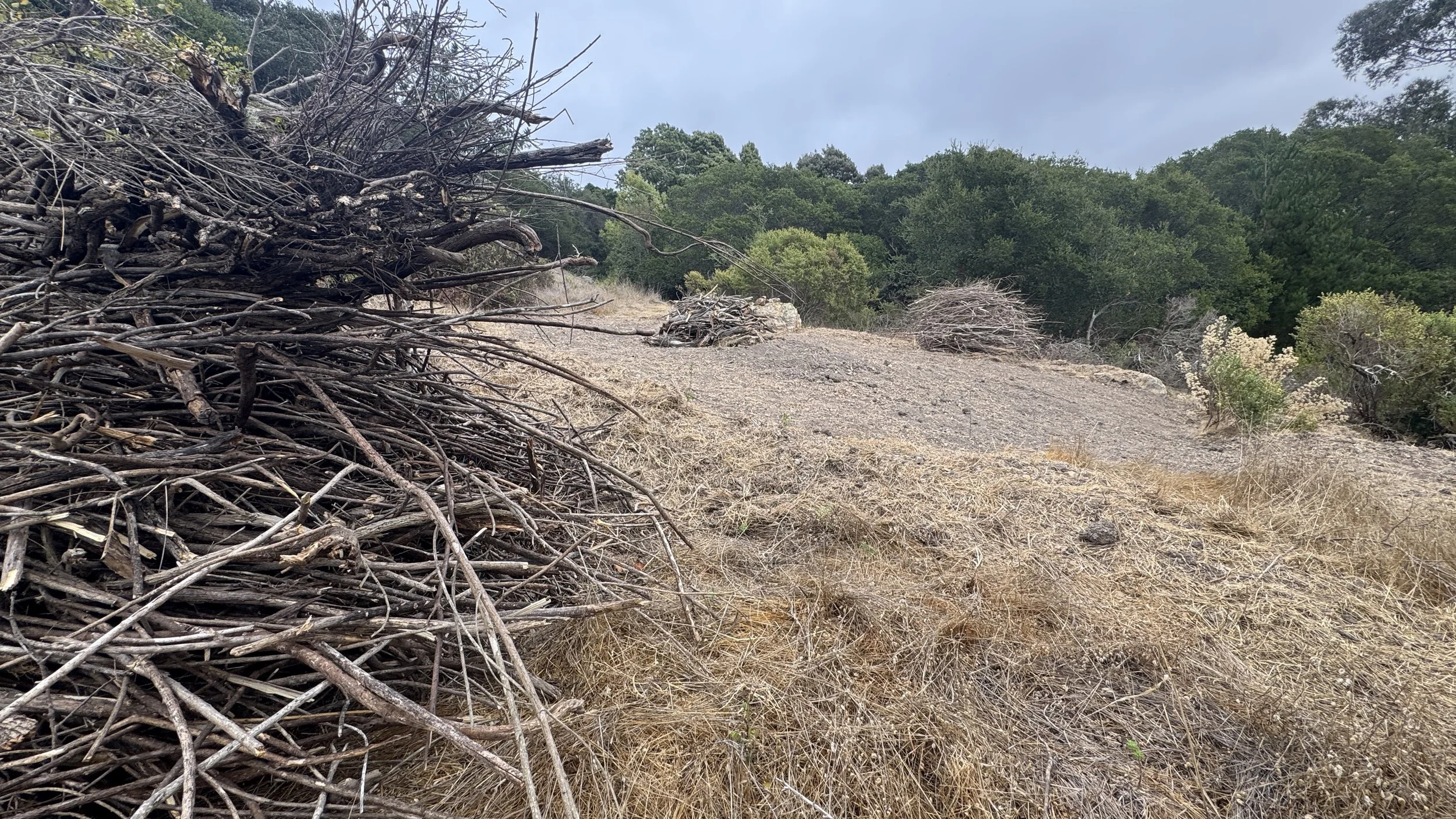
Reduce fire risk
The HNA is a Wildland–Urban Interface (WUI) site classified as a high fire risk zone with close proximity to homes and schools.
Top contributors to fire risk:
Invasive grasses
Dense, forest-like thickets of french broom
Dessicated coyote brush branches
Invasive fire prone trees
What have we done to reduce fire risk?
Thatched dead grasses
Trimmed dead branches from coyote brush
Removed thousands of french broom stalks one-by-one
→ Created ~100 piles of this flammable material
To reduce the fuel load, we already filled dozens of dumpsters but at the lower Madera area, the site is steep and difficult to access, and the volume of material is significant, hauling it away is not a viable option.
What happens next?
Partnered with El Cerrito Kensington Fire Department to strategize fuel removal - controlled burn method
Fire Chief Chase Beckman surveyed the site 2x to confirm that our piles were best-practice, and ready for a safe, controlled burn.
Scheduled a prescribed burn of these piles, targeting the week of April 11-19 2026 (cancelled - NEW DATE TBD)
50% of the piles will be burned
Fire fuel has been building up for decades. While this is the first controlled burn in years, the Fire Dept is confident that they can arrange a yearly burn moving forward until fuel load is reduced.
Estimated impact: piling reduced fire risk by 30%*, and then burning will reduce risk by 81% (Estimates from nonlinear fuel model)
While Indigenous stewards have used controlled burns for centuries to manage vegetation, we recognize that they can raise public safety concerns. That’s why we are advocating for practices that reduce smoke and improve efficiency, including producing biochar.
Future methods to explore
Flame-cap (ring-of-fire) kiln: an engineered, airflow-controlled system for producing biochar that burns cleanly and reduces emissions
There are portable ones for $2,000 https://tarterparts.com/products/ring-of-fire
Already used by Sonoma Ecology Center + recent scientific studies
Fundraising + biochar byproduct resale?